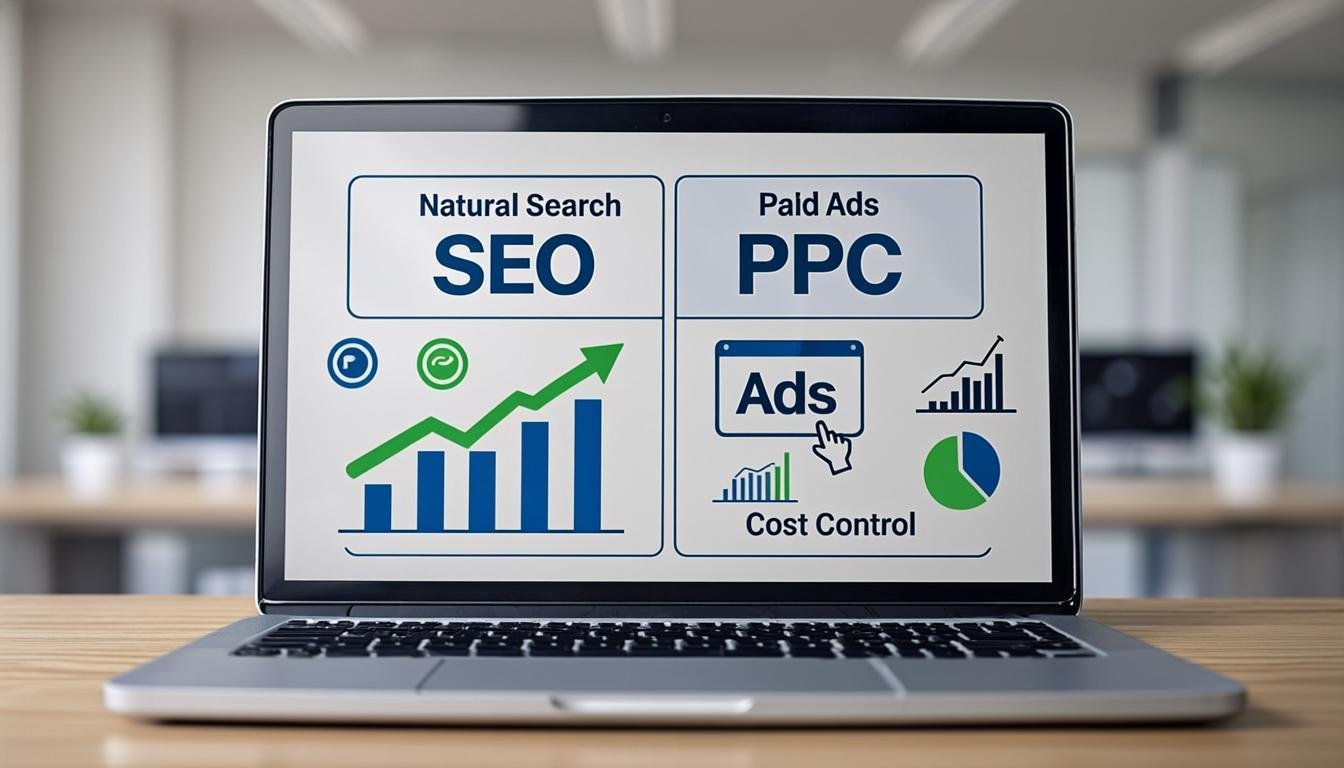

If you’ve ever stared at your blog’s analytics and wondered why traffic barely moves the needle, you’ve probably asked yourself the golden question: should I invest my time in SEO or throw money at PPC ads? It’s one of the most debated topics in digital marketing, and for good reason. Both strategies can transform a struggling blog or small business into a traffic-generating machine — but they work in completely different ways, with different timelines, budgets, and expectations.
In this guide, we’re going to break down SEO vs PPC in plain English. No jargon overload, no fluff. Just an honest, detailed comparison that helps you decide where to focus your energy (and your dollars) in 2026. Whether you’re running a brand-new blog, managing a small business website, or trying to grow your freelance writing side hustle, this article will give you a clear roadmap.
What Is SEO? A Quick Refresher
SEO (Search Engine Optimization) is the process of improving your website so it ranks higher in organic (unpaid) search results on engines like Google, Bing, and DuckDuckGo. When someone types “best productivity apps for writers” into Google, the sites that show up at the top without a “Sponsored” tag? That’s SEO at work.
SEO covers a lot of ground. It includes:
- On-page SEO: Optimizing your content with the right keywords, headings, internal links, and meta tags. If you want a deeper dive, check out our guide on top SEO tools for bloggers that can speed up this process.
- Off-page SEO: Building backlinks from other reputable sites, earning mentions on social media, and growing your domain authority.
- Technical SEO: Making sure your site loads fast, works on mobile, has clean site structure, and doesn’t have crawl errors.
- Content creation: Publishing high-quality, helpful articles that answer what people are actually searching for.
The core idea behind SEO is simple: create the best answer to a searcher’s question, and prove to Google that your site deserves to rank. The execution? Not so simple. It takes consistency, patience, and a willingness to adapt as algorithms evolve.
What Is PPC? The Basics Explained
PPC (Pay-Per-Click) advertising is exactly what it sounds like — you pay each time someone clicks on your ad. The most common platform for this is Google Ads, where your text ad appears at the very top of search results with a “Sponsored” label. But PPC also includes ads on social media platforms like Facebook, Instagram, LinkedIn, and even YouTube.
Here’s how it works in a nutshell:
- You choose keywords you want to target (e.g., “hire freelance blogger”).
- You set a maximum bid — the most you’re willing to pay per click.
- Your ad enters an auction every time someone searches for that keyword.
- Google factors in your bid and your Quality Score (how relevant your ad and landing page are) to decide whether and where your ad shows up.
- You only pay when someone actually clicks.
The beauty of PPC is speed. You can set up a campaign today and start seeing clicks by tomorrow. The downside? The moment you stop paying, the traffic stops. It’s like renting an apartment vs. buying a house — you get immediate shelter, but you’re not building equity.
How SEO Actually Works (Beyond the Buzzwords)
Google uses over 200 ranking factors to decide which pages appear first. Nobody knows all of them, but SEO professionals generally agree on the pillars that matter most in 2026:
Content Quality and Search Intent
Google’s algorithms have gotten scarily good at understanding what people actually want. If someone searches “how to start a blog,” they don’t want a five-sentence answer — they want a comprehensive, step-by-step walkthrough. Your content needs to match that expectation. Thin, surface-level content simply won’t rank anymore.
Backlinks and Authority
When other reputable sites link to yours, it’s like a vote of confidence. Sites with strong backlink profiles consistently outrank those without. Building these links through guest posting, digital PR, and creating linkable content (like original research, tools, or infographics) is a core part of any serious SEO strategy.
User Experience Signals
Google tracks how people interact with your site. Do they click your result and immediately bounce back to the search page? That’s a bad signal. Do they stay for three minutes, scroll through the whole article, and click an internal link? That’s a great signal. Factors like page speed, mobile responsiveness, and Core Web Vitals all feed into this.
Topical Authority
If you want to rank for “best blogging tools,” it helps if you’ve already published 30+ articles about blogging, tools, and related topics. Google sees your site as an authority on the subject, which gives you a significant ranking boost. This concept, known as topical authority, is one of the most powerful SEO strategies for bloggers. For more on growing your blog the right way, see our article on how to start a successful blog from scratch.
How PPC Actually Works (The Mechanics)
While SEO is a long game, PPC is built on real-time auctions. Every single time a search happens on Google, an instantaneous ad auction determines which ads appear and in what order. Here are the key components:
Bidding Strategies
You can choose how Google manages your bids. Options include:
- Manual CPC: You set the exact maximum cost per click.
- Maximize Clicks: Google spends your daily budget to get as many clicks as possible.
- Maximize Conversions: Google optimizes for actions like sign-ups or purchases.
- Target CPA (Cost Per Acquisition): You tell Google how much a conversion is worth, and it tries to hit that target.
Quality Score
This is the wildcard that makes PPC more nuanced than “whoever pays the most wins.” Your Quality Score (1–10) depends on your ad’s expected click-through rate, ad relevance, and landing page experience. A high Quality Score can actually let you outrank a competitor who’s bidding more than you. It’s Google’s way of rewarding relevant, helpful ads.
Ad Extensions
These are extra snippets of info — phone numbers, site links, reviews, location info — that make your ad bigger and more clickable. Using ad extensions can boost your click-through rate by 10–15%, and Google rewards higher CTRs with lower costs.
Targeting Options
PPC lets you get surgical with who sees your ads. You can target by location, device, time of day, language, audience interests, and even specific websites (through display ads). This level of control is something SEO simply can’t offer.
SEO vs PPC: The Big Comparison Table
Let’s cut to the chase. Here’s a side-by-side breakdown of how these two strategies stack up across the factors that matter most:
| Factor | SEO | PPC |
|---|---|---|
| Cost | Mostly time and content investment; some tools cost $50–$200/mo | Direct spend: $500–$5,000+/mo depending on industry |
| Time to Results | 3–12 months for meaningful traffic | Immediate (within days of launching) |
| Traffic Sustainability | Long-lasting; can generate traffic for years | Stops the moment you stop paying |
| Click Trust | High — organic results get ~70% of clicks | Lower — ads get ~30% of clicks on average |
| Control | Limited — Google decides if and where you rank | Full control over position, messaging, targeting |
| Scalability | Gradual; requires more content and links | Fast — increase budget to increase traffic |
| Targeting | Keyword-based; limited audience control | Granular: location, device, time, demographics |
| Barrier to Entry | Low cost, high learning curve | High cost, moderate learning curve |
| Data & Testing | Slower feedback loops | Real-time data; fast A/B testing |
| Long-term ROI | Excellent — compounding returns over time | Limited — ROI depends on continuous spend |
Cost Comparison: SEO vs PPC for Small Budgets
Let’s talk money, because that’s what most bloggers and small business owners care about first. If you’re working with a tight budget (and most of us are), the cost difference between SEO and PPC is massive.
What SEO Actually Costs
SEO isn’t technically “free” — anyone who tells you that is selling something. Here’s a realistic breakdown of what you might spend:
- DIY SEO: $0–$100/month (your time + a few tools like Ahrefs, Moz, or Semrush)
- Hiring a freelance SEO writer: $100–$500 per article
- Professional SEO agency: $1,000–$5,000+/month
- Backlink outreach tools/services: $50–$300/month
The biggest “cost” in SEO is your time. Publishing consistently, optimizing old content, building relationships for backlinks, and monitoring your rankings — it all adds up to dozens of hours per month. But if you’re willing to put in the work, SEO delivers an incredible return on that time investment.
What PPC Actually Costs
PPC costs can range from surprisingly affordable to shockingly expensive, depending entirely on your industry and target keywords:
- Low-competition niches: $0.50–$2.00 per click
- Medium-competition niches: $2.00–$8.00 per click
- High-competition niches (legal, finance, insurance): $15–$100+ per click
A typical small business might spend $500–$3,000 per month on Google Ads. For bloggers, it’s often closer to $100–$500/month for targeted campaigns. The key metric to watch isn’t cost per click — it’s cost per acquisition (how much you spend to get one email subscriber, one sale, or one lead).
Cost Per Acquisition: The Real Benchmark
Let’s say you’re spending $3 per click on PPC, and 5% of clicks convert to email subscribers. That means each subscriber costs you $60. If a subscriber is worth $10 to you (through eventual purchases or ad revenue), you’re losing money. But if you’re selling a $200 course and 2% of subscribers buy, each customer costs you $3,000 to acquire — and that might still be profitable if your course has good margins.
With SEO, the cost per acquisition drops dramatically over time. An article you publish today for $200 might bring in 500 organic visitors per month, generating 25 email subscribers per month — forever. After three months, you’re paying pennies per subscriber. After a year, the cost is essentially zero. That’s the power of compounding SEO value.
| Timeline | SEO Cost Per Lead (Estimate) | PPC Cost Per Lead (Estimate) |
|---|---|---|
| Month 1 | Very high (minimal traffic) | $15–$60 (depends on niche) |
| Month 3 | $30–$80 (traffic building) | $15–$60 (stable) |
| Month 6 | $10–$30 (rankings improving) | $15–$60 (may increase due to competition) |
| Month 12 | $2–$10 (strong rankings) | $15–$60 (inflation pressure) |
| Month 24+ | Under $1 (evergreen content compounding) | $15–$60+ (costs tend to rise over time) |
Timeline Comparison: When Do You See Results?
This is where the SEO vs PPC debate gets really interesting — and sometimes frustrating for new bloggers.
SEO Timeline: The Slow Burn
Let’s be brutally honest. If you publish your first blog post today, it might take 6–12 months before you see any meaningful organic traffic. Google’s algorithm favors established sites with proven track records. A brand-new domain has zero authority, zero backlinks, and zero trust.
Here’s a realistic SEO timeline for a new blog:
- Months 1–3: Publishing content, establishing on-page SEO, building initial backlinks. Traffic: 10–100 visits/month.
- Months 4–6: Some long-tail keywords start ranking. Traffic: 100–500 visits/month.
- Months 7–12: Competitive keywords begin moving up. Traffic: 500–2,000 visits/month.
- Year 2: Compound growth kicks in. Traffic: 2,000–10,000+ visits/month.
The key word here is consistent. Bloggers who publish 2–4 high-quality articles per week for 12 months straight almost always see significant growth. Those who publish sporadically tend to stall. If you want to understand how consistency pays off, check out our piece on blog monetization strategies that actually work.
PPC Timeline: The Fast Track
PPC is the opposite. You can set up a Google Ads campaign on Monday and have traffic flowing by Wednesday. There’s no waiting period, no sandbox, no algorithm to appease. You pay, you show up.
But “fast results” doesn’t mean “instant profits.” Most PPC campaigns go through an optimization phase where you’re essentially paying to learn what works:
- Week 1–2: Campaign launches. High cost per click, low conversion rate. You’re gathering data.
- Week 3–4: You’ve identified which keywords, ads, and landing pages perform best. Optimization begins.
- Month 2–3: The campaign starts humming. Costs stabilize, conversions improve.
Even with PPC, expect to lose money (or break even) during the first month or two. It takes data to optimize, and data costs money. Smart advertisers budget for this learning phase and don’t panic when initial ROAS (return on ad spend) looks rough.
When Should You Focus on SEO?
SEO isn’t right for every situation. Here are the scenarios where SEO deserves the lion’s share of your attention:
1. You’re Building a Long-Term Blog or Business
If you plan to be running your blog or business three years from now, SEO is non-negotiable. The compounding nature of organic traffic means that every article you publish today becomes a long-term asset. Unlike paid ads, which disappear when you stop funding them, SEO content can generate traffic for years.
2. You Have a Limited Advertising Budget
Can’t afford to drop $1,000/month on Google Ads? That’s fine. SEO levels the playing field. A well-written, thoroughly researched article can outrank a competitor who’s spending thousands on ads — if it genuinely serves the reader better. SEO rewards effort and quality over budget size.
3. You’re Targeting Informational Keywords
People search for things like “how to monetize a blog” or “best writing tools 2026” to learn, not to buy. These informational queries are incredibly difficult to advertise against profitably — nobody clicks an ad for a free guide. But they’re perfect for SEO, because you can answer the question and build trust, then funnel readers toward your products or services later.
4. You Want to Build Authority and Trust
Showing up organically in search results carries credibility that ads just can’t match. Studies consistently show that organic results receive significantly more clicks than paid ads. When someone finds you naturally, they’re more likely to trust you.
When Should You Focus on PPC?
There are plenty of situations where PPC is the smarter play — or at least the necessary one.
1. You Need Traffic Immediately
Launching a new product? Running a time-sensitive promotion? Need leads for your service business this month? PPC delivers. There’s no faster way to get eyeballs on your offer. You can’t wait six months for SEO to kick in when you’ve got bills to pay.
2. You’re Testing a New Niche or Product Idea
Before you invest months writing 50 SEO articles about a topic, why not run a $200 PPC campaign to see if there’s actual demand? If people click your ad and convert, you’ve validated the idea. If they don’t, you just saved yourself months of wasted effort. PPC is the ultimate market research tool.
3. You’re Targeting High-Intent, Commercial Keywords
When someone searches “hire blog writer” or “buy standing desk,” they’re ready to take action. These commercial-intent keywords are perfect for PPC because the searcher already knows what they want. The conversion rates on commercial keywords are often 5–10x higher than informational ones.
4. You Have a Proven Funnel and Want to Scale
If you know that for every $100 you spend on ads, you generate $300 in revenue, PPC becomes a math problem, not a gamble. Once you’ve dialed in your campaigns, the only limit is how much you’re willing to scale. Many seven-figure businesses were built almost entirely on paid advertising for this exact reason.
Google Ads Basics for Beginners
If you’ve never run a Google Ads campaign, the platform can feel overwhelming. Here’s a simplified walkthrough to get you started without burning through your budget:
Setting Up Your First Campaign
- Choose your campaign type: For beginners, “Search” campaigns are the way to go. These are the text ads that appear when people search on Google.
- Select your geographic targeting: Start local. If you’re a freelance writer in Austin, target Austin. If you’re selling digital products, go broader but consider language targeting.
- Set your daily budget: Start small. $10–$20/day is enough to gather meaningful data without risking a big loss.
- Choose your keywords: Use Google’s Keyword Planner (free with a Google Ads account) to find relevant keywords. Start with 10–20 keywords, focusing on exact and phrase match types to avoid wasting money on irrelevant searches.
- Write your ads: Keep them specific. Include your keyword in the headline, state a clear benefit, and have a strong call to action.
- Set up conversion tracking: This is crucial. If you don’t track conversions, you’re flying blind. Set up tracking for form submissions, purchases, or whatever action matters most to you.
Common Beginner Mistakes to Avoid
- Using broad match keywords: This is the #1 way beginners waste money. Broad match can show your ad for searches only loosely related to your keyword. Use phrase match or exact match instead.
- Not using negative keywords: Add terms like “free,” “DIY,” “jobs,” or “salary” if they’re irrelevant to your offer. Negative keywords prevent your ad from showing for searches that won’t convert.
- Skipping landing page optimization: Sending people to your homepage instead of a dedicated, relevant landing page kills conversion rates. Your landing page should match the promise in your ad.
- Not setting a daily budget cap: Google will happily spend your entire credit card limit if you let it. Always set a daily budget you’re comfortable with.
Social Media Ads: The Third Option Worth Considering
While most SEO vs PPC discussions focus on Google, social media advertising deserves a mention — especially for bloggers and small businesses. Platforms like Facebook/Meta Ads, Instagram, and LinkedIn offer a different kind of PPC that can be incredibly effective.
How Social Ads Differ from Search Ads
The fundamental difference is intent. With Google Ads, you’re catching people who are actively searching for something. With social ads, you’re putting your content in front of people who might be interested, even if they weren’t searching for you. It’s the difference between someone walking into a hardware store looking for a drill (search) and someone scrolling through Instagram who sees a cool drill they didn’t know they needed (social).
Best Platforms by Goal
| Platform | Best For | Typical CPC Range |
|---|---|---|
| Facebook / Instagram | B2C, ecommerce, blog content promotion, lead generation | $0.50–$3.00 |
| B2B services, professional courses, high-ticket consulting | $5.00–$15.00 | |
| YouTube | Brand awareness, video content, tutorials | $0.10–$0.30 per view |
| DIY, home decor, recipes, lifestyle blogs | $0.50–$2.00 | |
| TikTok | Gen Z audience, viral content, brand awareness | $0.20–$1.00 |
For bloggers specifically, Facebook and Instagram ads are worth testing for promoting your best content, building your email list, and driving traffic to affiliate offers. Start with $5–$10/day and test different audiences and creatives. Social ads are more forgiving than Google Ads for beginners because the auction dynamics are simpler.
The Long-Term Value of SEO: Why It Compounds
Here’s something most SEO guides don’t explain well enough: SEO is an asset that appreciates over time. Think of every blog post you publish as a digital property. Alone, each one has limited value. But together, they form a portfolio that grows in worth as your domain authority increases, your content library expands, and your backlink profile strengthens.
Consider this scenario:
- You publish 100 blog posts over two years (about 1 per week).
- Each post generates an average of 50 organic visits per month after maturing.
- That’s 5,000 monthly visitors — about 170 per day.
- If your ad revenue is $15 RPM (revenue per 1,000 pageviews), that’s $75/month in passive income.
- And it keeps growing as your older content gains more authority and you publish new posts.
Now imagine scaling to 300 or 500 posts. That’s when SEO starts feeling like a machine that runs on autopilot. Many successful bloggers report that 60–80% of their traffic comes from organic search after two to three years of consistent effort. This is exactly why we recommend treating your blog as a long-term business, not a side hobby.
Evergreen Content: The Gift That Keeps Giving
The smartest SEO strategy is to focus on evergreen content — articles that will remain relevant for years. “How to start a blog in 2026” will become outdated. “How to write a compelling blog introduction” won’t. The more evergreen content you publish, the more stable and predictable your traffic becomes.
Content Pruning and Updating
SEO isn’t just about publishing new content. It’s also about maintaining what you already have. Google rewards fresh, up-to-date content. Going back to update your older articles with new information, better formatting, and improved internal linking can give them a significant rankings boost — often with a fraction of the effort required to write something new from scratch.
Combining SEO and PPC: The Hybrid Strategy
Here’s the thing that most “SEO vs PPC” articles get wrong: it’s not an either/or decision. The most successful bloggers and small businesses use both, strategically, in ways that complement each other.
How to Combine Them Effectively
1. Use PPC for keyword validation. Before you invest months writing SEO content around a topic, run a small PPC campaign. Which keywords get the most clicks? Which ones convert? Use this data to prioritize your SEO content calendar.
2. Use PPC to fill traffic gaps while SEO builds. If you’ve just launched your site and organic traffic is near zero, PPC can keep the lights on. Run modest campaigns to drive initial traffic while your SEO efforts compound in the background.
3. Retarget organic visitors with PPC. Someone visits your blog via Google, reads your article, but doesn’t subscribe. With retargeting ads (available through Google Ads and Meta), you can show ads to these people as they browse other sites. It’s a powerful way to convert organic traffic into subscribers or customers.
4. Use SEO data to optimize PPC campaigns. Your organic search data is a goldmine. If you notice certain pages converting well organically, create PPC campaigns targeting those same keywords. If Google Analytics shows that a specific audience segment loves your content, target that same segment with paid ads.
5. Dominate the full search results page. When you rank organically AND have an ad showing for the same keyword, you own more real estate on the search results page. Studies show this dual presence increases total clicks significantly compared to either channel alone.
Budget Allocation: How to Split Your Resources
One of the most common questions is: “How should I divide my budget between SEO and PPC?” There’s no universal answer, but here are some frameworks based on different situations:
The 80/20 Rule for Established Blogs
If your blog has been around for 6+ months and you’re seeing organic traffic grow, allocate roughly 80% of your time/budget to SEO and 20% to PPC. SEO is your engine; PPC is the turbo boost for your best-performing content and promotions.
The 50/50 Split for New Businesses
If you’re launching a new business and need leads or sales immediately, split things more evenly. Use PPC for immediate results while building your SEO foundation. As organic traffic grows, gradually shift resources toward SEO.
The PPC-First Approach for Product Launches
When you’re launching a new product, course, or service, PPC should take 70–100% of your marketing budget for the first 2–4 weeks. Drive traffic fast, gather data, and optimize. After the launch, dial back PPC and let SEO take over for sustained traffic.
| Scenario | SEO Focus | PPC Focus |
|---|---|---|
| Brand-new blog (under 6 months) | 70% | 30% |
| Growing blog (6–18 months) | 80% | 20% |
| New product/service launch | 20% | 80% |
| Service business needing leads | 40% | 60% |
| Established site with revenue | 60% | 40% |
ROI Comparison: SEO vs PPC Over 24 Months
Let’s look at some numbers to put the ROI question into perspective. Imagine a blogger who has $500/month to invest in marketing. Here’s what the projected returns might look like over two years:
Scenario A: 100% SEO Investment
That $500/month goes toward content creation, SEO tools, and occasional backlink building. In months 1–6, traffic is minimal. By month 12, the site is generating 5,000+ monthly visitors. By month 24, that could be 15,000–25,000 monthly visitors from organic search alone. The total investment: $12,000. The traffic asset: permanent and growing.
Scenario B: 100% PPC Investment
That $500/month buys roughly 250–500 clicks per month (depending on the niche). Month-over-month traffic is stable but flat. After 24 months, total spend is $12,000 and total traffic is roughly 12,000–24,000 visits — but there’s no lasting asset. If you stop paying, traffic drops to zero. That said, if conversions are strong, the revenue generated during those 24 months could far exceed the spend.
Scenario C: 70% SEO / 30% PPC
Most experts consider this the sweet spot. $350/month on SEO, $150/month on PPC. You get the long-term compounding of SEO plus the immediate traffic and data insights from PPC. By month 24, you might see 10,000–20,000 organic visitors per month plus targeted PPC traffic for your highest-value offers.
The bottom line: SEO has a higher long-term ROI, while PPC offers faster and more predictable short-term ROI. The best approach is almost always a combination of both.
Real-World Case Studies
Case Study 1: The Solo Blogger Who Went All-In on SEO
Sarah started a personal finance blog in early 2024. With a $200/month budget, she couldn’t afford meaningful PPC campaigns. Instead, she published 3–4 long-form articles per week, focused on low-competition long-tail keywords, and did her own link building through HARO (now Connectively) and guest posting.
Results: By month 6, she was getting 800 monthly visits. By month 12, she crossed 5,000 monthly visits and started earning $200–$400/month from display ads and affiliate marketing. By month 18, she hit 15,000 monthly visits and was earning over $1,500/month passively. Total investment: roughly $3,600 over 18 months.
Case Study 2: The Small Business That Leveraged PPC
Mike runs a web design agency targeting local businesses in Denver. He needed clients immediately, not six months from now. He invested $2,000/month in Google Ads targeting keywords like “web design Denver” and “small business website Colorado.”
Results: Within the first month, he received 15 leads and closed 3 clients worth $8,000 in total revenue. Over the next 12 months, his PPC campaigns generated $120,000 in revenue on a $24,000 ad spend — a 5x return. He simultaneously built his SEO presence and now gets 40% of his leads from organic search.
Case Study 3: The Hybrid Approach That Scaled Fast
A content creation agency used both channels strategically. They ran Google Ads targeting “hire content writer” ($5–$10 CPC) to generate immediate leads. At the same time, they published SEO content about content marketing, which built their authority and drove organic traffic. Within a year, their organic traffic generated more leads than their paid campaigns — at a fraction of the cost.
According to industry benchmarks from Smart Insights, businesses that combine SEO and PPC see an average of 25% more clicks and 27% higher profits than those using just one channel.
Beginner Recommendations: Where to Start
If you’re just starting out and feeling overwhelmed by all of this, here’s a prioritized action plan:
Month 1: Lay the Foundation
- Set up Google Search Console and Google Analytics (both free).
- Install an SEO plugin if you’re on WordPress (Rank Math or Yoast).
- Do basic keyword research and publish your first 5–10 articles.
- Ensure your site is mobile-friendly and loads fast.
Months 2–3: Build Momentum
- Publish 2–3 articles per week consistently.
- Start building backlinks through guest posting on relevant blogs.
- If you have budget, set up a small Google Ads campaign ($100–$200/month) to test your best keywords.
- Use PPC data to refine your SEO content strategy.
Months 4–6: Scale What Works
- Analyze which articles are gaining traction and double down on those topics.
- Update and improve your top-performing older content.
- Increase PPC budget for campaigns that are converting.
- Start building an email list (this is critical — it’s the one traffic source you fully own).
Months 6–12: Optimize and Diversify
- Expand into social media advertising for content promotion.
- Explore retargeting campaigns to convert organic visitors.
- Consider hiring freelance writers to scale content production.
- Regularly audit your SEO performance and adjust your strategy.
For a deeper look at what it takes to succeed as a blogger in today’s competitive landscape, check out our comprehensive guide on blogging mistakes to avoid as a beginner.
Final Verdict: Which Is Better?
We’ve covered a lot of ground, so let’s bring it all together. The honest answer is that neither SEO nor PPC is universally “better” — they’re tools designed for different jobs. But here’s how I’d summarize it:
Choose SEO if: You’re in it for the long haul, you have more time than money, you’re building a content-driven blog, and you want traffic that compounds over time. SEO is the tortoise in the race — slow, steady, and ultimately the winner.
Choose PPC if: You need traffic or leads now, you have a proven offer that converts, you’re testing a new market, or you’re running a time-sensitive promotion. PPC is the hare — fast out of the gate but requiring constant fuel.
Choose both if: You want the best possible results. Use SEO to build a permanent traffic foundation and PPC for immediate results, data-driven insights, and scaling your highest-value content. This is what the most successful bloggers and small businesses do, and it’s what I recommend for anyone who can manage both.
At the end of the day, the best marketing strategy is the one you actually execute consistently. Whether you pick SEO, PPC, or both, the key is to start, track your results, and keep improving. The bloggers and business owners who win aren’t the ones who pick the “perfect” strategy — they’re the ones who commit, learn, and adapt.
Frequently Asked Questions
Is SEO really free?
Not exactly. SEO doesn’t require direct ad spend, but it costs time, effort, and often money for tools (keyword research, analytics, link building). A good SEO tool suite runs $50–$200/month. If you hire writers or an agency, costs climb significantly. Think of SEO as “sweat equity” — you’re investing effort now for free traffic later.
How much should a small business spend on Google Ads per month?
It depends on your industry, goals, and margins. Most small businesses start with $500–$1,500/month. Local service businesses can sometimes get results with $300–$500/month. The key is to start small, gather data, and scale what works. Never start with a budget you can’t afford to lose during the learning phase.
Can I do SEO and PPC at the same time with a small budget?
Absolutely. Start with a 70/30 split (SEO/PPC). Focus most of your effort on content creation and on-page SEO, and allocate a small PPC budget ($100–$200/month) for testing keywords and driving immediate traffic to your best content. Use the PPC data to make smarter SEO decisions.
How long does it take for SEO to start working?
For a brand-new site, expect to wait 3–6 months before seeing meaningful organic traffic. Competitive keywords can take 6–12+ months. Low-competition, long-tail keywords might start ranking in 4–8 weeks. The timeline depends on your niche, content quality, site authority, and consistency.
Is PPC worth it for bloggers?
It can be, but cautiously. PPC is most useful for bloggers who have a clear monetization path — email funnels, digital products, or high-paying affiliate offers. If you’re only earning through display ads (at $5–$15 RPM), PPC will almost certainly lose money. Test with small budgets and track your cost per subscriber or cost per conversion carefully.
Which is better for affiliate marketing: SEO or PPC?
SEO is generally better for affiliate marketing because the margins are thin. Most affiliate commissions are $10–$50 per sale, and PPC clicks can cost $2–$10 each. Unless your conversion rate is excellent, PPC will eat into your profits. SEO lets you rank for buyer-intent keywords without paying per click, making the economics much more favorable.
Does social media advertising count as PPC?
Yes. Any advertising model where you pay per click (or per impression/engagement) falls under the PPC umbrella. Facebook Ads, Instagram Ads, LinkedIn Ads, Pinterest Ads, and YouTube Ads all operate on PPC or similar pay-per-performance models. The principles of targeting, testing, and optimizing are the same as Google Ads.
What’s the biggest mistake beginners make with SEO vs PPC?
The biggest mistake is treating them as mutually exclusive. Beginners often pick one and ignore the other entirely. Some go all-in on SEO and get frustrated when traffic takes months to arrive. Others blow their budget on PPC without building any organic foundation, creating a dependency on paid traffic. The smartest approach is to start with SEO as your foundation and layer in PPC strategically for immediate needs and data gathering.