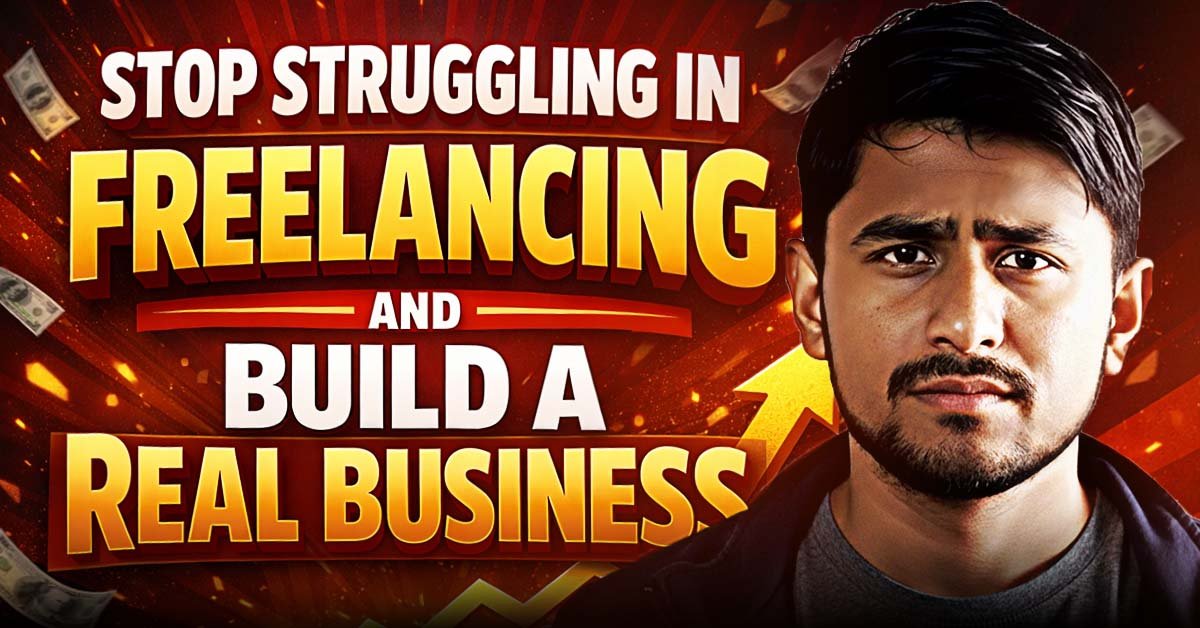
By Ghulam Mohiuddin | 5+ Years of Freelance Experience
Let me be honest, this is my freelancing journey. When I started freelancing, I felt like I had finally found freedom. No boss, no fixed hours, no office. Just me and my work. But within a few months, a strange thing happened. My clients became my boss. Some people would message me at night and I would work till midnight. I would make frequent changes without any extra pay. I was stressed, underpaid, and honestly confused.
We all start freelancing so that we can work at our own pace. But with time, clients start controlling us. If all this sounds like your life, like your freelancing story, then I want to tell you something. It’s not your fault. You were just never taught the right way.
I’m Ghulam Mohiuddin. I’ve been freelancing for the past five years, providing content writing and website designing services. My freelancing journey was very difficult. I had to learn a lot over time. I’ve moved from a struggling freelancer to running a truly creative business. In today’s article, I’m going to tell you how you can stop struggling in freelancing and build a real business. I’m going to tell you everything that has helped me build a real business as a creator in my freelancing.
The Real Problem: It Starts With Your Mindset
Before we talk about strategies that can break you out of the freelancing loop, let’s first talk about mindset. Because this is where most new freelancers make the mistake.
When someone new wants to start freelancing, the first thing they do is turn to YouTube. There are videos everywhere—be your own boss, work whenever you want, learn a small skill and sell it on Fiverr, create an account and earn dollars. Everything seems so easy.
ALso Read: Direct Clients vs Freelance Platforms
The problem is that this type of content creates a lazy mindset. People think that freelancing is very easy, it does not require much effort and results are achieved quickly. Then when the real work starts, when clients do not come, when rejections are received, when it becomes difficult to talk to clients, then people are unable to understand the situation. Then most of the people give up. They say that freelancing is fake, money cannot be earned online. But this is not true.
The truth is that they were not mentally prepared. Their mindset was wrong. They thought that freelancing is just an easy job, but it is a business. Treat it like a business. First, clear your mind. Freelancing is a business, and like every business, it takes time, strategy, and consistent effort. Once you accept this, everything changes.
Also Read: The Reality of Freelancing
Lesson 1: Stop Selling Skills — Start Selling Solutions
This was my biggest mistake when I started as a website designer. I only focused on how good my work looked. I thought if I learned tools like WordPress and Shopify, clients would automatically come. I was wrong.
Clients don’t care much about your software or skills. They care about the results of their business. This was a big shift for me that changed everything.
Old Approach vs. New Approach
- Old approach: “I’m a WordPress professional and I can build any type of website for you. I’m a professional in everything.”
- New approach: “I’ll design your portfolio website in such a way that clients will hire you quickly.”
See the difference? The first line was just talking about tools. It was just saying I have skills. Okay. The second line is talking about real business results. The purpose of a portfolio website is to pitch and acquire clients. Here, I’m understanding their problem and telling them that I’m the solution to their business.
Practical tip: Before pitching your next client, ask yourself, “What real problem do my services solve for their business?” Then build on that.
Lesson 2: Pick a Niche and Own It
My second mistake was that I said no to every project. Whether a client offered Google Discover work, a business website, or a website design service, I initially accepted anything. I became a do-it-all freelancer, and that was my biggest problem.
When you’re a generalist, any other freelancer can easily replace you. You have no unique value. Clients don’t remember you, and you’re always competing on price. As soon as someone offers you a lower rate, the client immediately chooses that person and your work is over.
When I narrowed my focus and concentrated on physical branding experience, specialized packaging, specific website design, and content writing, my value increased significantly. Now, when a company or client needs help with website design or content writing, they know I’ve worked in the field.
Why Niching Down Works
- You’re not just an option, you’re the first choice
- Clients trust specialists more than generalists
- When you’re known for something specific, you can charge higher rates
- It’s easier to build a portfolio and reputation in your focused area
Action Step: Write down all the services you offer. Then look at your portfolio. Then ask yourself which service you like best and what type of clients you can get the best results for. That will be your niche. Gradually focus on it. Don’t try to be a jack of all trades; become an expert in one.
Lesson 3: Stop Arguing Over Price — Make Clients Feel the Cost of Not Hiring You
I used to waste a lot of energy justifying my pricing to clients who wanted an hour’s work done for $10 or $20. And honestly, it never worked. After an argument, clients become smarter. It just wastes your time and energy.
Cheap clients want more work done for less money. Moreover, they themselves aren’t clear on what they want. So they keep asking for revisions. This isn’t right. Change that, then change some more. It’s very irritating.
The real problem was justifying my price. I needed to show them how much they could lose if their branding or design wasn’t right. I realized this later. Before, I couldn’t even have a proper conversation to make them understand why my price was fair. Now, I clearly mention in my description what I do, what services I provide, and what I charge for. I also clearly mention revisions.
Now, I don’t just say that my price is this much. Let me put it this way: If your website doesn’t feel clear and professional on first impression, you’re losing potential clients daily who simply walk away. This cost is much lower than the loss that can occur from poor branding.
This approach is called the anchor and loss technique. It shifts the conversation from cost to value. You convince the client that not hiring you could actually be costly.
Remember: If you’re attracting cheap clients, it’s often because you’re positioning yourself as a cheap service. Change your positioning. The right clients will come to you on their own.
Also Read: How to Get your First Freelance Client Without a Portfolio
Lesson 4: Turn Your Portfolio Into a Sales Tool, Not a Gallery
Initially, I used to work only on Fiverr. I used to say, “This is my portfolio, this is my profile, this is everything.” But when I started getting fewer clients, I did some research and realized the true value of a portfolio. Then I created a proper portfolio.
At first, my portfolio was just a mess. Logos, banners, Web Design, and random projects were all mixed up. I had learned Photoshop, so I added that too. From web design to article writing, I put everything in one place. When clients visited, they would get confused. They didn’t understand what I was an expert in.
Such a portfolio only brings small and random projects. A good client comes along occasionally, but great clients rarely come.
The Case Study Method
The biggest difference came when I converted my portfolio pieces into case studies. Each case study tells a clear story:
- What was the client’s problem?
- What brief did they give me?
- What changes did I identify?
- What solution did I design, and why?
- What was the final result?
When a client sees a presentation like this, they don’t just see pretty images. They see your thinking process. They understand how you solve problems. This is where trust is built.
Then the client begins to view your project in the same way. They imagine how you would analyze and solve their project. It becomes clear to them why you are a good fit for their project.
Remember: If you have just two or three strong case studies, they are more powerful than 20 random images. Quality and clarity always trump quantity.
Lesson 5: Set Clear Boundaries With Every Client
This was the area where I completely failed. Initially, I had no rules. If a client messaged at night, I would reply. If they asked for a fourth revision, I would do it. If they added extra work to a project, I would accept it, whether I got paid extra or not. My mindset was that if you’ve just started freelancing, just work hard and take on every job.
In this cycle, I simply kept fulfilling every demand from clients. The turning point came when I established a proper standard operating procedure for every project. I had to do this because it was not humanly possible to do so much work. I even fell ill in between. Then I had to decide that this system will not work anymore.
What My Client Agreement Now Includes
- 50% advance payment before work starts
- Number of revisions included — usually two or three
- Exact delivery timeline
- Separate charge for any scope changes or extra services
When you set the rules in advance, two things happen. First, serious clients respect you more. Secondly, clients who want to exploit you disappear on their own. And that’s actually a good thing.
Remember: If you control the process, you control the project. If you don’t set boundaries, clients will set their own, and then you might not like them.
Lesson 6: Stop Doing Everything Alone — Build a Small Team
I used to do everything myself, website designing, article writing, literally everything. I thought I was saving money, but in reality, I was limiting my growth.
The truth is, a one-person operation has limits. You can only work a limited number of hours and handle a limited number of projects. And when you do everything yourself, both small and large, you can’t focus on the high-value work that grows a real business.
When I started getting bigger projects, I started delegating. I hired a content writer for specific tasks who wrote articles for my websites. I hired an SEO specialist who handled the website’s SEO. This allowed me to focus on the important parts of freelancing and also started finding direct clients.
Also Read: Direct Clients vs Freelance Platforms – Which Is Better
Instead of doing everything myself, I became the creative director and client manager. The result was that my work quality improved. I started managing 10 to 20 projects at a time, and my income grew significantly.
How to Do Client Hunting as a New Freelancer
Mindset shift: Hiring people isn’t an expense; it’s an investment in your time. And your time is your business’s most valuable asset.
Lesson 7: Build Your Personal Brand and Stop Depending on Platforms
For a long time, my entire business was based on Fiverr and Upwork. When orders were good, life felt good. When orders dropped, I would panic. I had no control. I was completely dependent on the algorithm.
I got the wake-up call when I thought if these platforms closed my account tomorrow, my entire business would be destroyed overnight. Then I started building my personal branding and reaching out to direct clients.
I started marketing directly to brands. I contacted decision-makers and business authorities. I shared my case studies and work processes with them. I clearly showed them how I was different.
Today, 70% of my income comes from direct clients. Fiverr and Upwork are now just a small part of the business, not the foundation. Over time, you have to change yourself and your strategies.
How to Start Building Your Personal Brand
- Create a professional LinkedIn profile and clearly showcase your results
- Share your case studies and work processes on social media
- Contact decision-makers who need your services
- Be consistent — show up regularly so people remember you
- Collect testimonials and display them clearly
I’ve mentioned several times in my portfolio how I moved from Fiverr and Upwork to direct client hunting. Today, I’m making the most money from direct client hunting. So, I won’t go into too much detail. I just want to say that in these five years, I’ve earned more from direct client hunting than I’ve ever done before.
Final Thoughts: You’re Not Struggling Because You’re Unlucky
After five years in the freelancing industry, I can confidently say one thing: freelancing is amazing, and the money can be amazing, but only for those who treat it like a real business.
If you’re still struggling, it’s not because you’re not talented. In most cases, one of the following is missing:
- The right mindset
- A clear vision
- A strong portfolio
- Professional communication
- Personal branding
- A proper system
The good news is that all of these things can be fixed. Just start with one thing. Choose the lesson from this article that matches your current situation and take action today. Not tomorrow.
I’m not perfect today, and I never will be. I’m still learning. But I’m no longer confused. And that’s the biggest difference.
Your Next Step
Now your next step is to reread the lessons above and think about what you can improve. Then write them down and create clear action steps for yourself. Real change in freelancing doesn’t come from just reading, it comes from doing.
If you found this article helpful, share it with a freelancer friend who also happens to read it. And if you have any questions or want to share your freelancing story, comment below. I read every comment.

Ghulam Muhiudeen is a passionate blogger, SEO specialist, and online earning expert. He started his career with freelancing and provided content writing and website designing services on Fiverr from 2022 to 2024. During this time, he experienced firsthand the market’s intense competition, algorithm changes, and inconsistent income.