I am Ghulam Muhiudeen. It’s been five years since I’ve been earning money online and creating content. When I started, freelance writing was just a skill. I had no idea this skill would become so powerful in the future.
The AI Hype and Fear in 2026
It’s 2026, and the buzzword is everywhere: AI has arrived, writers’ jobs will disappear, and content creators will replace them. People are so scared that they give up before they even start writing.
But may I share my real observation?
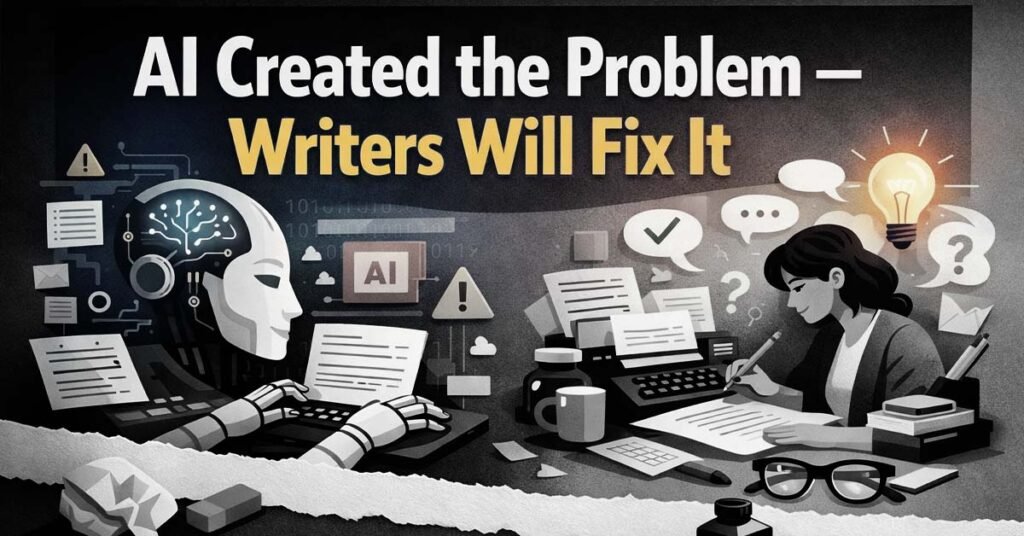
AI created the problem… and writers will fix it.
How Companies Fell for AI Content – And What Happened Next
Over the past few years, I’ve seen many companies start using AI tools. They believed they would create content quickly, save money, and double profits. Initially, everyone thought this was the future.
But now, slowly, reality is setting in. AI content is fast, but it lacks feeling. It lacks real experience. It lacks the human touch that connects readers.
And now, the market is flooded with the same type of content everywhere. Same lines, same tone, same structure. When everyone starts writing the same way, brand differentiation disappears. This is where the real opportunity begins.
The Rising Demand for Human Storytelling
Recently, I’ve noticed a surge in demand for storytelling even in the tech industry. Coding is important, but growing a brand requires a strong story. And AI can’t create a strong story; only a human can.
I use AI myself. But I don’t depend on it. I use it as an assistant, not a replacement.
Does Freelance Writing Have a Future After AI?
If you’re also wondering, “Does freelance writing have a future after AI?” I’ll be honest—it does, but only for those who deliver real value.
Also Read: How to Become a Content Writer with No Experience
The era of average content is coming to an end in 2026. Now, only those writers will thrive who develop their voice, share their experiences, and make the reader feel like a human wrote it. AI has oversaturated the market. Now it’s the writers’ job to bring back quality.
And if you’re serious, this isn’t the time to be afraid. This is the time to be smart.
Big Tech Companies Paying Premiums for Communication and Storytelling
If you look at the online world in 2026, at first it seems like everything is under AI’s control. Everyone is saying, learn coding, acquire tech skills, that’s the future. When AI started coding and OpenAI showed videos demonstrating how easily code is generated, I thought perhaps technical people would win.
But the picture turned out to be a bit different. According to a Business Insider report, major companies like Netflix, Microsoft, OpenAI, and Anthropic are paying six-figure salaries not for coding, but for communication and storytelling roles.
Meaning, they need people who can:
- Explain complex ideas simply.
- Convert difficult things into normal human language.
And honestly, that’s what content writing is all about.
Why AI Content Falls Short
AI can generate words, but the problem is that the content often appears complete. It’s empty inside.
- There’s no strategy.
- No clarity.
- No real insight.
It’s just paragraphs that look good, but nothing stays in the reader’s mind. In 2026, AI is everywhere. So much content is being created that there’s a lot of noise.
This noise has made it a bit difficult for writers to find clients. I went through this phase myself last year. Many companies have integrated AI into their workflow. They felt that now the need for writers will decrease. But a year later, they realized that AI alone wasn’t enough.
Now, those same companies are looking for experts who can:
- Create real, meaningful, and authentic language.
- Build a connection with their audience.
- Make the message feel, not just write.
And this is where freelance writers enter.
AI Made Mediocre Writing Easy – Great Writing More Valuable
If you develop your own voice, add your experience, and deliver value, not just words, then AI isn’t your competition. AI is just a tool. You’re the one who makes the real difference.
When AI started gaining momentum on the internet in 2022, almost everyone was making the same prediction—writers would disappear, brands would rely solely on machines. Content would become completely automated.
And is it true? For a while, it seemed that way. AI content was everywhere. Blogs, posts, emails, captions—everything was being generated by AI. But what really happened?
AI has made mediocre writing easier… and great writing more important.
Now, reports like those from Business Insider make it clear that writing isn’t dying. In fact, it’s growing. Only the type has changed. Now a new word is trending online—slogaganda. It means AI slop plus propaganda. Content that appears complete, but is hollow inside.
The Noise from AI Content – And Why Quality Wins
What’s the result of AI creating content so easy these days? Everything seems the same:
- Same ideas.
- Generic advice.
- Surface-level analysis.
- Confident tone, but zero clarity.
Now everyone has become a “writer.” Press a button, and words appear on the screen. When everyone can publish instantly, the noise becomes so overwhelming that real value is drowned out.
I check LinkedIn daily. Every second post is about AI. And honestly, even those posts often seem to be written by AI. After a while, everything starts to feel repetitive. Clients feel it. Brands feel it. Users feel it too.
The result hasn’t been that writers have become irrelevant. Quite the opposite has happened. Great writing has become even more valuable because it cuts through the noise.
Companies are finally realizing that:
- Writing isn’t a simple skill.
- It’s not a low-barrier job.
- It’s not a commodity.
Writing is the foundation of communication. And this is great news for freelance writers. When businesses hire you for blog posts, they’re not just paying for words. They’re paying for results—leads, customers, trust. Content builds brand trust. And trust leads to sales.
I’ve experienced this firsthand. Whenever I pitch a brand, I don’t just say, “I write well.” I show them that I understand their audience. I research my ideas. I give them a clear picture of their value. Companies pay premiums when you make complex ideas simple and compelling.
How to Thrive as a Freelance Writer in the AI Age
Now the question is, how do you utilize this shift in your freelance writing business?
Storytelling is no longer optional. If you only write what’s already been written 1,000 times, you’ll become part of the noise. The topic may be common, but your angle should be unique.
- Add your experience.
- Add short stories.
- Add real-life observations.
AI can’t copy these things. Clients need clarity. Clients need stories. Clients need real experience. You’re not just a writer. If you can understand the brand, improve their messaging, and give them content direction, then you’re not just writing words… you’re solving a problem.
There’s only one way to stand out in the age of AI—level up your skills:
- Understand the company.
- Understand their audience.
- Understand their product.
- Then write.
Update your LinkedIn, your website, your pitches. Don’t just write “content writer.” Make it clear that you’re a communicator, a strategist, and understand the brand voice. These days, clients pay more to writers who provide clear messaging and direction, not just paragraphs.
Showcase Your Process and Build Your Brand
AI has flooded the market. Now is the time for real writers to prove their value. The third thing you can do is showcase your process. Don’t just say you write well. Show people how you write.
I personally believe that when you share your writing process on LinkedIn—how you break down an idea, create an outline, and improve a draft—it becomes clear to clients that you’re not a random writer. You’re working with a system.
You can share before-and-after examples. Explain how you improved an AI draft, how you added clarity, and how you added a human angle. When you share all this openly, you establish yourself as an expert.
Fourth thing—build a personal brand. I always say that freelance writing isn’t just a game of skill, it’s a game of trust. Your brand isn’t just the colors of a logo.
- Brand is how you handle late payments.
- How flexible you are with clients.
- What you share on social media.
- What your overall vibe is.
When a client sees your profile, they should feel that you are serious, consistent, and professional. Your writing style is part of your brand, but style alone isn’t enough. You need proof. You need presence. You need personality. You need consistency across every platform.
Evolve Your Services and Pricing
Then it comes to services. If companies are paying high salaries to skilled communicators, shift your services in that direction. Don’t limit yourself to just blog writing.
- You can write thought leadership.
- You can work on brand messaging.
- You can do executive ghostwriting.
- You can offer content strategy.
- You can create email sequences.
I always recommend picking one or two things and delving into them. You don’t need to learn everything at once. For example, if you want to learn email sequences, start your own email list. Write a welcome series. Practice. Then turn it into client service.
The next important thing is rates. If you’re adding new skills and providing more value, why keep your rates the same? Many writers make this mistake. Skills level up, but pricing remains the same. This shift doesn’t mean you’re competing with AI. You’re competing with brands’ needs—they need to stand out. And a brand that wants to stand out won’t settle for cheap content.
I myself keep changing my title on LinkedIn. Sometimes content writer, sometimes copywriter, sometimes B2B, sometimes adding SEO-related terms. This attracts different types of clients. Positioning matters a lot.
Embrace AI as a Tool, Not a Threat
And one last thing—dont think of AI as a competitor. Think of it as a tool. I use AI myself. To take direction, to generate ideas, to improve speed. But the final decision is mine. The creativity is mine. The judgment is mine.
If you openly say you use AI tools and know how to use them smartly, clients gain confidence that you’re modern, updated, but not completely AI-dependent. The freelance writer of 2026 is someone who adapts. Who isn’t afraid of tools. Who develops their own voice.
Honestly, I think the future of writing is strong. Just the average writing time is running out.
Tell me, how is your freelance writing journey going right now? Are you getting clients or is it going slow? I genuinely want to know.

Ghulam Muhiudeen is a passionate blogger, SEO specialist, and online earning expert. He started his career with freelancing and provided content writing and website designing services on Fiverr from 2022 to 2024. During this time, he experienced firsthand the market’s intense competition, algorithm changes, and inconsistent income.