By Ghulam Muhiudeen | Digital Creator & Freelance Business Expert
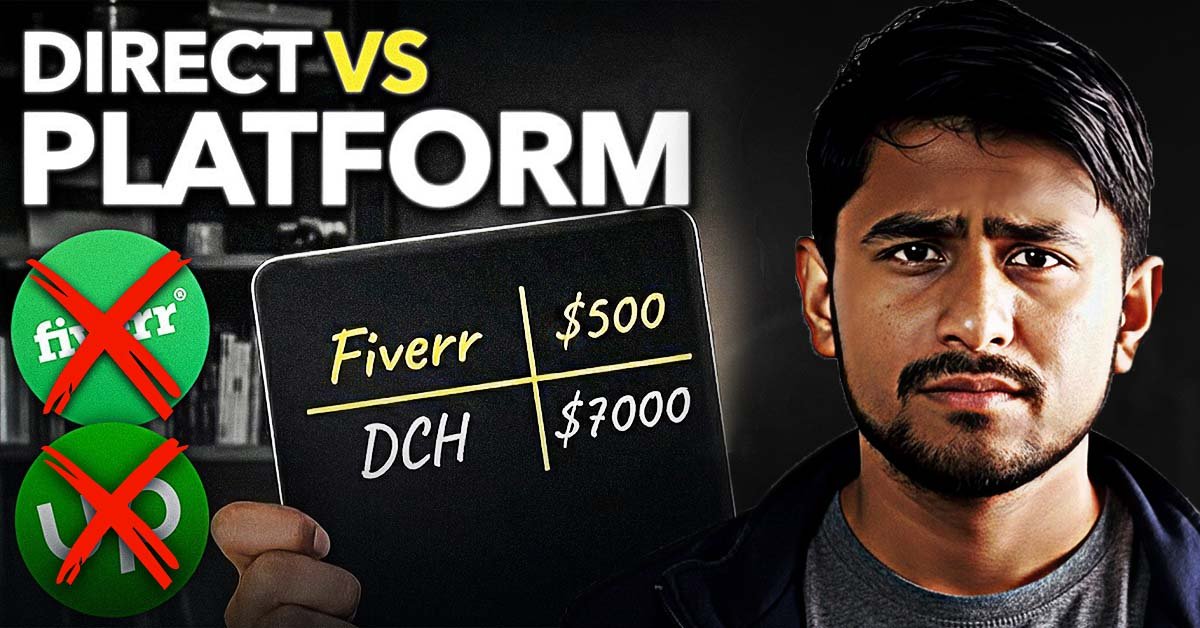
Friends, to be honest, new freelancers are always confused about whether they should pursue direct client hunting or work on a freelance platform. When you start freelancing, the most important decision is: should you use a freelancing platform or hunt for clients directly? Both options have their own advantages and challenges, and they can have a significant impact on your freelancing career.
I’m Ghulam Muhiudeen, a digital creator, and I’ve been freelancing and content writing for the past five years. I’ll explain step-by-step, clearly, which path you should follow, so you don’t make the wrong decision.
What Are Direct Clients and Freelance Platforms?
Before comparing freelancing platforms and direct client hunting, let’s first clarify this so we’re all on the same page.
Freelancing platforms are marketplaces, like Fiverr or Upwork, where clients post their projects and freelancers apply or get hired through their profiles. Here, the platform acts as a middleman between you and the client.
Direct client hunting means you find clients yourself — through cold outreach, social media, LinkedIn, or sometimes by calling local businesses — without involving a platform.
Both have their strengths and weaknesses. Now we’ll break them down one by one. I’ve worked on both myself, and believe me, both have their ups and downs. If you understand them correctly, they can save you time, money, and unnecessary stress.
Key Differences: Direct Clients vs. Freelance Platforms

1. Fees — How Much Are You Actually Losing?
The biggest issue with freelance platforms is the fee. Most platforms charge a 20 percent service fee on every order. This means if you earn $1,000, the platform takes away $200.
It doesn’t end there:
- The platform also charges clients separately
- When you withdraw your money through Payoneer, Payoneer also takes its cut
- After that, you get a little less exchange rate
- And when the money arrives in your local bank account, you have to pay taxes there as well
If you calculate everything, a $1,000 project might end up with $700 to $750 in your pocket.
There are no platform fees in direct client hunting. Yes, you have to set up your own payment system, such as creating a small US LLC and generating a payment link through Stripe. Stripe also charges a small fee, but it’s significantly lower than other freelance platforms. You can also receive payments from clients directly through Payoneer. The overall savings are significant.
2. Competition
The biggest issue with freelance platforms is competition. When a client posts a business website project on Fiverr or Upwork, thousands of freelancers apply to that single project. Just think about that number.
No matter how good your profile is, you’re competing against a huge crowd. Sometimes the chances of getting selected feel like winning the lottery.
For example, if I become a client on Fiverr and search for a service, I’m presented with a lot of gigs. I first look at their reviews. Then, I choose the ones with good reviews and a low price. This way, most clients select top freelancers. Beginners find it difficult to get orders. This is why many freelancers are unable to take new orders.
3. Pricing Power — Who Controls the Rate?
On a freelance platform, clients have an idea of market rates. They browse multiple sellers, compare prices, look at reviews, and then choose the cheapest and best-rated one. Thus, a race to the bottom begins.
You are forced to lower your rates, even if your work is of higher value.
In direct client hunting, clients don’t have such detailed market knowledge. They can do some online research, but they don’t have the full picture that platform buyers have. This gives you more margin to price your services fairly.
If you have a strong portfolio and good communication skills, you can charge premium rates. Your skills are the same, but the client is different. The work you do for $20 on the platform can be sold to a direct client for $200.
But on freelance platforms, if you demand a higher price from the client, the client has more options. This is why there’s a risk that the client might leave. Your hands are a little tied here, and you often have to lower your rates.
4. Stability and Long-Term Growth
This is a topic that not many people talk about, but it’s the thing that scares me the most about freelancing platforms. Your Fiverr or Upwork account can be banned at any time.
It doesn’t matter if you’ve been on the platform for three years, have hundreds of five-star reviews, and have never knowingly violated any policy:
- Clients can misuse the refund system
- You can accidentally violate a policy
- Sometimes, an account gets suspended due to a mistake that is not your fault
If your entire income depends on this one account, everything can be lost in a day. I’ve personally seen people earning thousands of dollars a month, only to have their account disappear one day without any backup.
Direct client hunting allows you to build your own brand. Clients get to know you as a person, not just through a five-star profile. Your portfolio, website, social media presence, reputation — it’s all yours. No one can take it away from you. This is where real stability in freelancing comes from.
Also Read: How to Do Client Hunting as a New Freelancer
So Should You Stop Using Freelance Platforms?
No. Absolutely not — and I want to make that clear.
I started my career on a freelance platform. It’s where I learned things I probably wouldn’t have learned anywhere else. Platforms teach you:
- Communicating professionally with clients from different countries
- Working to deadlines, because time is ticking and real money is at stake
- Setting your pricing in a competitive market
- Handling client feedback and improving your work
These skills are useful throughout your life — whether you work with direct clients, run an agency, or do something else.
The problem arises when freelancers rely solely on platforms and don’t build their own. That’s where the real risk lies.
My advice is simple: do both. Work on platforms to learn and earn, but also start building your direct client base. Don’t wait for your account to be blocked, then realize you should have started sooner.
How to Start Getting Direct Clients (Step-by-Step)

Now let’s get a little practical. If I were starting today, I would follow these steps.
Step 1: Watch a Free Client Hunting Course
Learn the basics of client hunting before you reach out to anyone. There are free resources available on YouTube where you can learn how to find leads, write outreach messages, and follow up. Start there first.
Step 2: Build Your Portfolio Website
When you message a potential client, the first question is: “Can I see your work?”
If you don’t have a website, your credibility immediately diminishes. A professional portfolio website shows clients that you’re serious. It should include the following:
- A clear description of what you do (be specific — instead of writing “I’m a graphic designer,” write “I design logos and brand identities for small businesses”)
- Examples of past projects with images and results
- Testimonials or reviews from previous clients
- A simple contact form so clients can easily reach out
- Links to your social media profiles
Building a website isn’t as difficult as people think. You can get hosting from Hostinger (with a free domain), then install WordPress with one click. Add your portfolio, write a short bio, and you’re ready.
Showcase all the projects you’ve done while freelancing on your website. Highlight client reviews and results. Give your website a professional look.
Also Read: How to Get your First Freelance Client Without a Portfolio
When a client sees real results and real reviews on your website, they trust you more quickly than if they just received a random message.
Step 3: Grow Your Social Media Presence
Many freelancers ignore this — then wonder why no one knows them.
Choose the platforms where your clients spend time. LinkedIn, Instagram, Facebook, and Twitter/X are especially important for most freelancers. Start posting daily:
- Share tips related to your skills
- Show behind-the-scenes footage of your work
- Share results with clients
You don’t need to be a content creator. Just be consistent and genuine. Gradually, people will start to see you as an expert in your field. Then, business owners will come to you on their own, without you having to go to them.
Keep all your social media links visible on your portfolio website. This will show clients that you have a real and active online presence.
Step 4: Start Your Outreach
Once your website is ready and your social media is active, it’s time to start outreach.
Find businesses that might need your services:
- New businesses without a website
- Local shops with a weak social media presence
- Companies running bulky ads
- Brands with outdated designs
Contact them via email, LinkedIn, or a phone call. Keep your message short, friendly, and direct. Tell them who you are, what you noticed, and how you can help. Don’t be salesy. Just be helpful.
The Honest Truth: Both Paths Have Value
Freelancing platforms are not your enemy. They are a great starting point and give you real experience. But they should never be your only income source.
Direct client work gives you freedom, better rates, less competition, and a long-term focus. Yes, it takes a little more hard work in the beginning — building a website, growing social media, learning outreach. All of this takes time. It’s not an overnight task. It may take 3 to 6 months, or even longer.
Start with a freelancing platform. Build your reviews. Complete orders well. Value users. Solve their problems. When you feel, “Yes, the time has come. I have the resources,” then build your portfolio. Display your client reviews and completed orders as a portfolio on your website so you look professional.
The smartest strategy is to combine both. Every week, devote some time to your platform profile and some time to your website. Focus on direct outreach and personal branding. Gradually, as your direct income grows, you will feel more confident and secure. Because you’ll know that even if the platform cancels your account tomorrow, your business won’t collapse.
This is the confidence every freelancer wants. Freelancing earnings aren’t stable, but through direct clients, you can convert them into a long-term business.
Final Thoughts
If you’re reading this and currently only work on Fiverr or Upwork, I’m not saying you should quit. I’m just saying you should add one more step to your career so you can make your freelancing stable.
Start small. Start building your portfolio website this week. In 2026, freelancing platforms are good for quick wins and learning, but direct clients give you freedom, higher rates, and security.
I personally work on both — freelancing platforms and client hunting. Platforms for learning and regular gigs, direct clients for growth.
- If you’re new, start with platforms
- But also start client hunting and branding
- This will build your confidence and create a backup plan
Remember, everyone makes mistakes. They’re part of everyone’s journey. You can achieve a lot and improve your life.
If you have any questions about direct client hunting or building your freelancing business, be sure to ask in the comments. I’ll definitely answer.

Ghulam Muhiudeen is a passionate blogger, SEO specialist, and online earning expert. He started his career with freelancing and provided content writing and website designing services on Fiverr from 2022 to 2024. During this time, he experienced firsthand the market’s intense competition, algorithm changes, and inconsistent income.